I Turned 16 in 1990. Here's What I Absorbed About Beauty.
On heroin chic, anti-aging culture, and what happens when you start questioning what you were taught to desire.
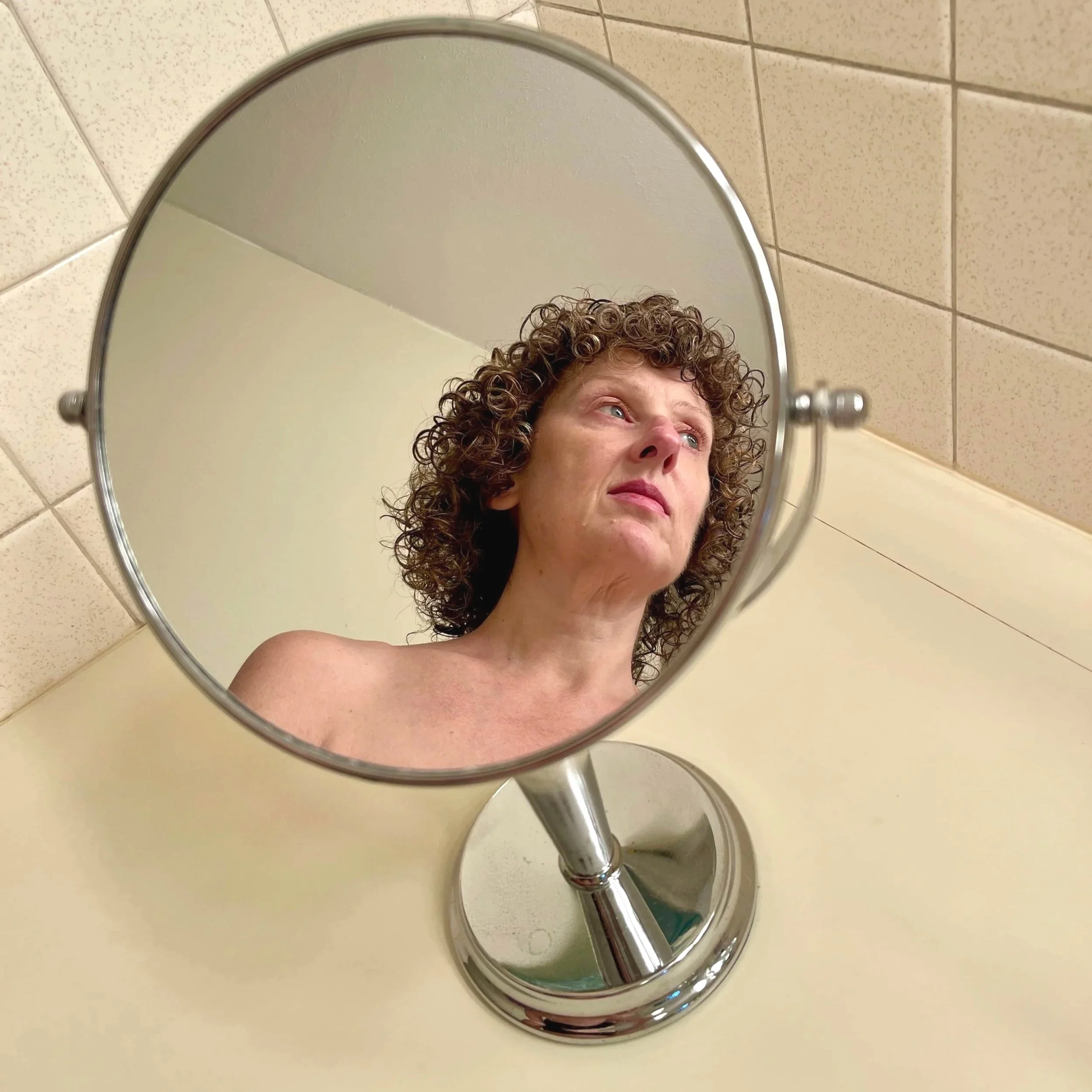
I got out of the shower the other morning and caught sight of my body in the mirror. Immediately I felt an old instinct arrive right on cue: Look away. Cover up.
But this time I didn't.
Instead, I did this thing I've been doing lately. I looked. Stared, in fact. And I talked to myself like I was auditioning for a role in a film where the main character has lost the plot in the most wonderful possible way.
"Wow. Look at my breasts. They are SO beautiful." A pause. "My goodness, my stomach is incredible." Another pause, accompanied by a dramatic gesture toward my legs. "Oh HELLO. Would you look at how amazing you are?!"
It's completely over the top. And that's the point. The absurdity seems to be the thing that gets past my defenses, because somewhere in the ridiculousness of it, something registers. I am remarkable. My body is remarkable. And if I have to perform a one-woman show in my bathroom to get there, fine.
Let me back up.
For the past couple of months, I've noticed some body-image issues resurfacing for me. Always in front of a mirror when getting dressed or undressed. I catch sight of the usual suspects, and I feel what I can only describe as disgust.
The first time it happened I was caught off-guard. Me, the woman who has been loudly and proudly talking about celebrating our aging bodies for years now. Celebrating MY aging body. With photos, no less, that I've intentionally shared. Not artsy, softly lit pics either. I'm talking no-filter, no-fucks images that do nothing to detract from my so-called flaws, but pointedly highlight them instead.
So it was a surprise to find myself back in a place I thought I'd worked my way out of. But being a voice in the pro-aging space, I wanted to actually examine the reaction rather than override it. And what I landed on is something I haven't been able to stop thinking about since.
I turned 16 in 1990.
I spent my late adolescence absorbing the aesthetics of a decade that gave us heroin chic and super-waif as aspirational categories. I watched Victoria Beckham get weighed on live television two months after giving birth. I witnessed Kate Moss get widely celebrated for saying "nothing tastes as good as skinny feels." I internalized BMI as a health metric and a moral one.
These weren’t fringe ideas. They were everywhere. And I embraced them completely, the way you do when you’re young and the popular culture is handing you a template and telling you this is what desirable looks like. This is what acceptance feels like.
But where did those standards actually come from? Who introduced them, who benefited from them, and who upheld them?
As I pull at the thread of who informed the beauty standards we remain steadfastly loyal to today, and when I sit with what we know about the men at the center of that world and what they actually wanted from women and girls, something in me goes very still and feels very sick.
Because when I look at what the “ideal” female body actually looked like during the years I was forming my sense of what I was supposed to be, I notice something. It wasn’t womanly. It was pre-womanly. Slim to the point of erasure. Not much in the way of curves or softness. As close to a girl’s body as you could get while still technically being in the frame of womanhood. And the women who came closest to that ideal were the ones on magazine covers, billboard campaigns, and movie screens.
We were told this was just the aesthetic of the times. Every era has one, right? But I’m asking a different question now. Whether the men who had the power to decide what we saw and what we aspired to, what we spent our money and our mental energy trying to become, whether some of those men had reasons of their own for wanting women to look as young and as small as possible.
Could it be, that being slim-bodied, smooth-skinned, luscious locks up top but hair-free down below, are actually beauty ideals that were steeped in the preferences of predators? Men whose attraction to “underage women” (who are, in no uncertain terms, children) rippled outward into a culture that rewarded the erasure of female maturity.
Anti-aging culture is not an accident. And while we’re busy shaving, plucking, and smoothing ourselves into compliance, we’re inadvertently helping to shape a more sinister culture. One where young girls are sexualized and everyone looks the other way.
Every single insecurity we have about our appearance is by design. The beauty industry can’t make its billions if we’re all walking around feeling worthy and whole. And how many women do you personally know who feel a deep sense of contentment and confidence in who they are and how they look?
Not enough, I’d wager that much.
I’ve been in Zoom rooms where every single woman on the call had something negative to say about her body. I’ve looked around at the squares on my screen, at the sheer brilliance of these women, women who are intelligent, creative, innovative, and capable, and I have wanted to weep with the knowledge that this is what we revert to. Our hang ups. Our desire to hide away. Wanting to be different. Smaller. Less.
And I now know, with a clarity that didn’t exist for me at 16, 26, or 36, that we didn’t arrive at this naturally. We were taught it. How curious, not to mention convenient, that women were duped into seeing other women as a bigger threat than the men whose attention we vied for.
This is not separate from my work. This is exactly my work. If I’m going to help women feel a sense of peace, ease, and purpose in their bodies and their lives, I want to tell the truth and name the red flags about what we’ve been conditioned and socialized to aspire to. Because the conditioning doesn’t simply fall away as we get older. If anything, it intensifies.
Anti-aging is a booming business because, if we buy into it, our desire to look younger only increases as our proximity to youth decreases.
I want women to reclaim the attention they’ve been spending on themselves as objects and redirect it toward themselves as human beings. As whole, beautifully-designed, wonderfully unique, worthy-of-their-own-time humans who don’t have to accept the fetishization of girls as a cultural norm, much less a beauty blueprint.
My ridiculous bathroom performances are part of that, too. The over-the-top compliments, the dramatic gestures toward my low-hanging breasts and thick legs. It’s ludicrous. It’s also medicine. Because the voice that says look away is so old and so loud that sometimes the only way past it is to be louder.
I’m 52 now. I’m further away from girlhood with every passing day. Why on earth would I want to chase a beauty ideal I’ll never hope to meet? Why would I willingly choose to be cruel to myself?
Again, my body is remarkable. I am remarkable. And I will say those words like a mantra, over and over again, until every ounce of shame that has ever clung to me has no choice but to disintegrate.
Every time I extend compassion to my midlife body, my inner teen and twenty-something experiences another wave of healing. And my future self is smiling at me, with her deep wrinkles and belly rolls, cheering me on all the way.
I'm Skylar — midlife guide and pro-aging advocate. I create ceremonies to mark midlife's rites of passage, and personalized meditations to help you tune out of the noise and into your own knowing.
If this is the kind of thinking you want more of, explore more of my writing on Substack.
Interested in working with me? Explore Touchstones or Ceremonies.